
Little River County Criminal Docket Searches
Search ARCourts is free. It covers appellate, Circuit Court, and state District Court cases across Arkansas. Pick Cases when you already hold a number or citation. Pick Participants for a name search. Then open Detail and set County Name to Little River. A court-location filter helps split the Little River County Circuit Court docket from the District Court docket. That matters when the same name appears at both levels. Results are informational only. They are not a certified court record.
Gather the full name, the likely court, and any case or citation number before you begin. There is no verified local criminal-number pattern published. So avoid forcing a civil-style code onto a criminal file. If the online result comes up empty or murky, call the Little River County Circuit Clerk for a felony. For a misdemeanor, call the District Court Clerk. MyFinePayment can match a city citation for payment. The District Court still owns the docket and any copies.
- Open Search ARCourts and select Cases or Participants.
- Expand Detail, choose Little River County, and narrow by court only when needed.
- Open the matching case and confirm its court, case type, filing date, and status.
- Read Events and Docket Entries in date order, with special care after a reset.
- Ask the proper clerk for an absent image or a certified record.
Little River County Criminal Docket Routes
Start by confirming the court level. Little River County Circuit Court is part of the Ninth West Judicial Circuit. It holds the felony cases. Misdemeanors and traffic matters belong to Little River County District Court. A city citation lives in a city ledger inside the unified county District Court structure. The statewide search can list more than one level at once. So a matching name alone never settles which record is the right one.
The clerk route follows the same split. Circuit Clerk Lauren Abney keeps Circuit Court criminal records at 351 N. Second Street, Suite 5, Ashdown. Reach her at 870-898-7212. District Court Clerk Kristi Lewis handles lower-court criminal records through the Courtroom Building at 2115 N. Constitution Avenue, Ashdown, at 870-898-7230. Both offices open weekdays from 8:00 a.m. to 4:30 p.m. A quick phone call beats a wasted trip when the portal gives no clear division.
| Matter | Little River court | Record contact |
|---|---|---|
| Felony charge | Circuit Court | Circuit Clerk |
| Misdemeanor | District Court | District Court Clerk |
| City citation | District Court city ledger | District Court Clerk |
| Federal offense | U.S. District Court | PACER, not Search ARCourts |
Criminal Dockets: What They Show
A Little River County criminal docket can display a Case Summary, Participants, Events, Offenses, Sentences, Milestone Tracks, and dated Docket Entries. The official Arkansas criminal cover sheet builds in fields for an offense code and description, offense date, count, felony or misdemeanor marker, class, arrest date, arrest tracking number, related cases, and other defendants. Treat those cover-sheet fields as a map of the data structure, not as proof that every public case screen fills in every field.
| Case Number | The court identifier for the matter; confirm the court and full value shown rather than guessing a format. |
|---|---|
| Offense | The accusation block, which may include code, description, date, counts, level, and class. |
| Events | Scheduled or recorded activity, when the portal has populated this block. |
| Docket Entries | Dated filings and court actions with description, detail, name or role, and document status. |
| Sentence | Outcome information that must be read apart from the initial charge. |
| Documents | Links to selected public images; “None” does not prove that no paper filing exists. |
Little River County publishes no verified local list of criminal disposition abbreviations. Rely on the portal's full description instead. If a label stays unclear, ask the clerk rather than borrowing a meaning from another county or state.
Little River County Criminal Outcome Records
A charge is an accusation, nothing more. It does not establish a conviction. Read the Little River County criminal court docket past the Offenses block. Later entries show a plea, trial, dismissal, sentence, or other final disposition. When several counts are listed, trace each one to its own result. Never stretch a single outcome across every charge without a docket entry to support it.
Dates do different jobs. An offense date marks when the alleged act occurred. An arrest date, filing date, and hearing date each mark later procedural steps. Start at the oldest entry, but trust the newest valid setting after a continuance. A status label helps, yet the dated record should always confirm it. The safest method joins the Case Summary to the chronological Docket Entries. It then opens linked documents where public access allows.
- Offense
- The charged act and its classification, not the final result.
- Plea
- The accused person's formal response, such as guilty, not guilty, or no contest.
- Disposition
- The recorded way a charge or case was resolved.
- Reset
- A later setting that displaces an earlier court date.
Note: A name match plus a charge line is not enough. Confirm the person, the court, the case number, and the final entry together.
Criminal Case Stages on the Docket
A Little River County criminal case follows a form- and rule-backed path. It begins with a charge, information, or indictment. From there it can run through first appearance or arraignment, bond decisions, pretrial motions, a plea or trial, and then disposition and sentencing. An appeal may follow. Real cases can branch off this path. So let the Search ARCourts wording control the specific docket.
Docket flow: Filing › Arraignment › Pretrial › Plea or Trial › Disposition › Sentencing
Read every stage by its date. A motion can sit on the docket well before the court rules on it. An arraignment is not a trial. A sentence is never the same entry as the charge. Document links can supply the text behind a row. But they work only where public access is allowed and the image is attached. The clerk keeps the official file behind the online sequence.
Little River County Criminal Court Divisions
Two Circuit Court divisions handle Little River County felony cases within Ninth West. Judge Tom Cooper sits in Division 1. His office is in Ashdown. Division 2 belongs to Judge Bryan Chesshir. His office is in Nashville. When Search ARCourts leaves a setting question open, knowing the division answers it. The state's Arkansas circuit judges directory posts the current public contacts for every division.
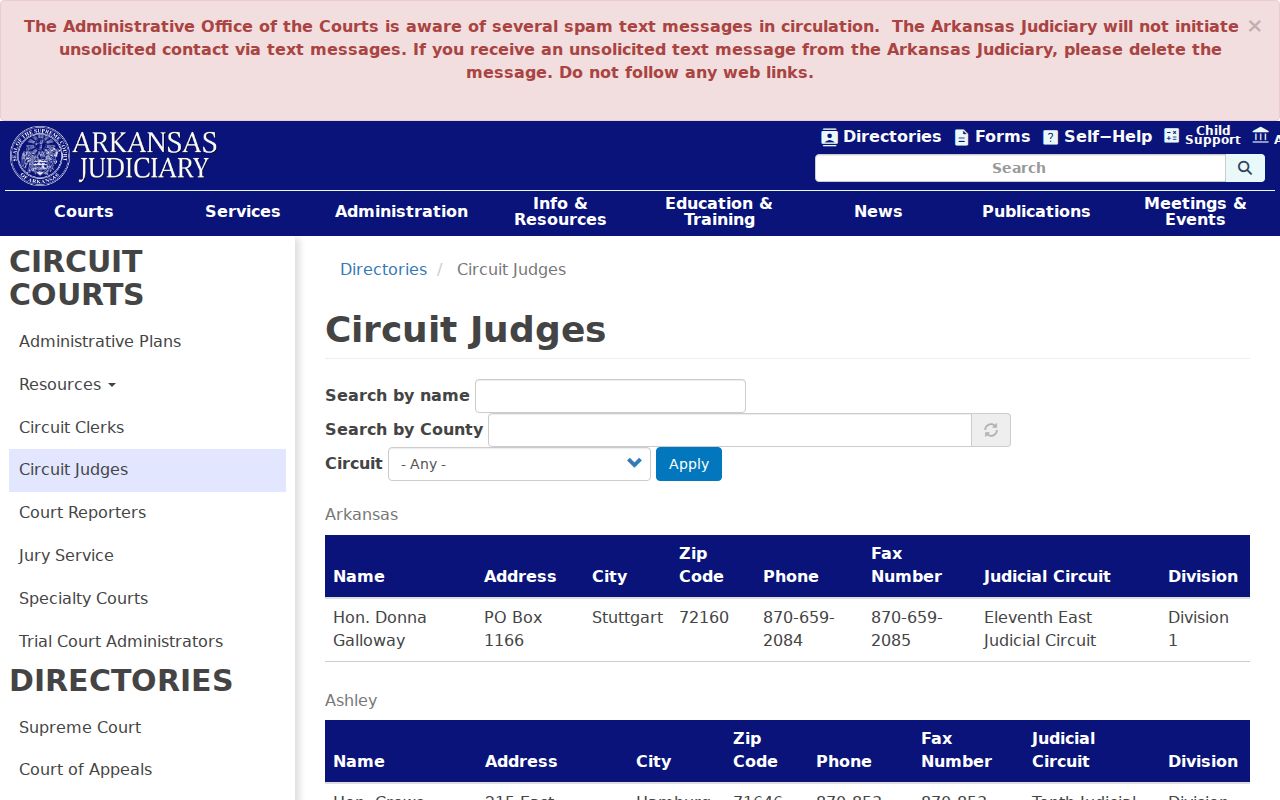
This division check works best once a case screen names the judge. It is not a docket, though. And for certified copies, the clerk, not the division office, is the office to call.
Little River County Criminal Docket Courts
Felony criminal dockets in Little River County belong to Circuit Court, the general-jurisdiction trial court. District Court is a separate court. It handles misdemeanor and traffic dockets. Its Ashdown, Foreman, and Winthrop departments all operate inside one unified District Court. Current administrative materials send active Ashdown and Foreman city proceedings to the Ashdown courtroom. So a city name in the ledger does not always signal a separate city courthouse or its own search system.
A District Court criminal appeal can move up to Circuit Court. Arkansas Rule 36 materials give a 30-day period to perfect the appeal. That is done by filing the certified District Court record with the Circuit Clerk. The Circuit Clerk lists a $150 District Appeal, Criminal Division fee. Timeliness and the certified record decide these appeals. So anyone pursuing one should rely on the actual rule and clerk instructions rather than an online summary.
Little River County Drug Court Docket
Drug Court is the only specialty docket the Ninth West administrative plan documents for the circuit. It has served participants since August 2003. They come from Pike, Howard, Little River, and Sevier counties. Sessions are held in Howard County. The program is voluntary for eligible nonviolent defendants. Pre-adjudication and post-adjudication paths are both available. It runs at least 18 months and includes court appearances, supervision, treatment, counseling, and testing.
For a Little River County criminal docket search, one point matters most. Search ARCourts may show events in the underlying criminal case. But do not expect it to expose a separate public file of treatment details. Administrative Order 19 and other confidentiality rules still apply. Successful completion may bring dismissal of the deferred case after plea. A violation or expulsion can send the matter back to the criminal division. That happens through a revocation process.
Practical reading: Follow the public underlying case, but do not treat the absence of treatment detail as a missing criminal docket entry.
Little River County Criminal Docket Settings
Little River County posts no searchable local calendar and no daily Circuit Court docket PDF. The current District Court plan does set recurring blocks for Little River traffic and criminal matters. Arraignments fall on the second Wednesday at 9:00 a.m., and trials on the fourth Wednesday at 9:00 a.m. Those blocks describe the court's schedule, not your case. They never prove a particular case is set on a given day.
Start with the citation or the filed notice. Then read Search ARCourts Events and the dated docket rows. If a continuance or reset shows up, trust the newest order or notice. Confirm with the clerk. District questions go to the District Court Clerk at 870-898-7230. Circuit questions go to the Circuit Clerk at 870-898-7212. The assigned division office serves as a backup check. The full Little River County Court Schedule helps separate a recurring block from a case-specific setting.
Access Rules for Criminal Dockets
Search ARCourts opens many Little River County criminal docket facts to the public. But Arkansas law, court rules, and case-specific orders set the limits. A missing search result proves nothing. It does not show a case never existed. Juvenile matters generally stay confidential. And a sealed criminal matter can vanish from ordinary public view. Sealing still does not destroy the physical court file.
The clerk can tell you the filing office and the published process. But the clerk cannot give legal advice on sealing eligibility. Little River County publishes no guaranteed processing time. It also publishes no local sealing form beyond statewide materials. It does publish no charge for a qualifying petition concerning a criminal case adjudicated after March 6, 2013. Restricted access may turn on party status, identification, or a court order.
Key Rules:
Arkansas Supreme Court Administrative Order 19 makes court records public unless law, rule, or order excludes them and protects sensitive identifiers.
Arkansas's Comprehensive Criminal Record Sealing Act sets eligibility and petition rules rather than automatic deletion.
Ark. Code Ann. §9-27-309 generally keeps juvenile arrest, detention, and proceeding records confidential, subject to statutory exceptions and court orders.
Want an official Little River County criminal court docket? Ask the Circuit Clerk or District Court Clerk for the certified record that court holds. Portal printouts come with a warning for a reason. They are not official court records.